When Moving Food Costs More Than Producing It: The Silent Crisis in Nigeria’s Agribusiness Economy
By Prince Basil Emeka Omeje
Global Council Member, World Agriculture Forum
Nigeria does not have a food production problem alone. It has a food movement problem.
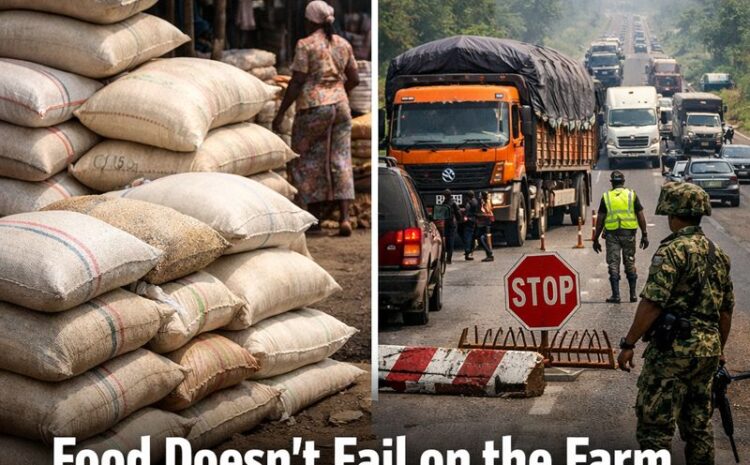
Across the country, farmers are producing. Traders are buying. Markets are open. Yet food prices keep rising, not because crops are scarce, but because moving food from where it is produced to where it is consumed has become an economic punishment.
The contradiction is stark.
According to Dr. Nnaemeka Onyeka Obiaraeri, In December, it cost an average of ₦4,300 to move a 50kg bag of rice from a factory in Kubwa, Abuja, to a warehouse in Owerri, a journey of over 500 kilometres. That same bag of rice cost ₦8,000 to move from Owerri to Arochukwu, a distance of less than 200 kilometres.
This is not an isolated case. It is a pattern.
Within Nigeria, and particularly across the South-East, short-distance food movement has become more expensive than long-haul transport. The reason is not fuel alone. It is a toxic mix of levies, extortion, fragmented authority, and policy neglect.
The Hidden Cost Between the Farm and the Market
Every additional checkpoint on a road is a tax on food.
Every informal levy is a surcharge on hunger.
Every delay increases spoilage, risk, and price.
Farmers pay for it through post-harvest losses.
Traders pay for it through shrinking margins.
Consumers pay for it at the market.
Nigeria loses an estimated ₦3.5 trillion annually to post-harvest losses. This figure is often discussed as a production failure. In reality, it is largely a logistics failure.
Food rots not because farmers do not work hard enough, but because transport is slow, unsafe, expensive, and unpredictable. Fresh produce waits on bad roads. Trucks are delayed by checkpoints. Perishables spoil while drivers negotiate passage.
This is not inefficiency by accident. It is inefficiency by design.
When Solutions Are Punished
In response to these challenges, private operators have begun investing in alternative, community-scale logistics solutions.
One such intervention involved importing five-wheel, three-ton capacity agro-haulage cycles, designed specifically to move rice and other commodities cheaply within rural and peri-urban communities. The plan was simple and practical: deploy 1,246 units, one per ward across the South-East, to reduce last-mile logistics costs, create jobs, and improve food flow within local markets.
These were not used machines. They were brand-new units, fitted with specially designed 300cc Laidong engines, built for durability and low operating cost.
The objective was clear: crash logistics costs, not raise them.
But at the point of entry, the project collided with Nigeria’s trade and tariff reality. Customs duties and tariffs imposed on these agro-logistics machines immediately pushed costs upward. Investors, understandably, must recover their capital. The result is inevitable. Costs are passed down the chain.
The very policy environment that should reward solutions instead punishes them.
In a country that cannot locally manufacture most agricultural logistics equipment, one would expect zero tariffs on haulage, cold chain, storage, drying, and processing machinery. Instead, these tools are treated as luxury imports.
The message is clear: survival is taxed, efficiency is penalised.
The Bigger Economic Blind Spot
Nigeria’s monetary policy rate sits at 27 percent. Inflation remains stubbornly high. Unemployment is widespread. Yet agribusiness logistics, one of the fastest ways to reduce food prices and create jobs, remains structurally ignored.
There is no coherent national agricultural logistics policy. Authority over roads, levies, and enforcement is fragmented across federal, state, and local agencies. Transport unions operate as price setters rather than service providers. Security checkpoints double as revenue points.
Meanwhile, export ambitions grow louder.
The contradiction is glaring. A country cannot compete in exports when it cannot efficiently move food within its own borders. Export corridors begin at the farm gate, not at the port.
Why This Must Become a Policy Fight
These issues cannot be resolved by individual operators alone. They require deliberate policy intervention.
That is why structured platforms matter.
The Presidential Agricultural Policy Dialogue convened by the Nigeria Agribusiness Group creates a space to address customs duties, transport barriers, and logistics reform at the highest level.
Similarly, Africa Growth Industries Exhange (AGIX Africa), in partnership with SECCIMA is convening a high-level government–private sector roundtable focused on agribusiness constraints in the South-East. The Nigerian Export Promotion Council, SEDC also needs to workout how to mitigate these issues. Logistics, post-harvest losses, and cost-of-movement are central to that conversation.
Importantly, agro-development and food security sit at the heart of the South East Development Commission’s Vision 2050 agenda, which will be further discussed at the upcoming stakeholders’ forum in Enugu.
These are not talk shops. They are pressure points.
The Real Question
The question Nigeria must answer is simple.
Does it want food to be affordable, or does it want food movement to remain a revenue extraction system?
Because until the cost of moving food is treated as a national economic issue, not a private inconvenience, prices will keep rising, farmers will keep losing, and consumers will keep paying for policy failure.
Food security does not fail on the farm. It fails on the road.
And until that truth is confronted honestly, no amount of production targets will feed the nation.
Prince Basil Emeka Omeje is the Founder and Executive Director of Africa Growth Industries Exchange (AGIX Africa) and a Global Council Member of the World Agriculture Forum (Netherlands). His work focuses on agribusiness policy, market access, and investment ecosystems across Africa.